Each species on our planet plays a role in the healthy functioning of natural ecosystems, on which humans depend. - William H. Schlesinger

Saturday, April 30, 2011

Passenger Pigeon & Golden Toad & Caribbean Monk Seal

The story of the Passenger Pigeon is one of the most tragic extinction stories in modern times. As recently as around 200 years ago they weren’t anywhere near extinction. In fact, they were actually the most common bird in North America, and some reports counted single flocks numbering in the billions.
During some migrations, the flocks flying overhead would stretch for over a mile and could take several hours to pass. It would have been impossible to imagine a North American skyline without them. Yet somehow the species went from being one of the most abundant birds in the world to extinction in only about 100 years. What happened?
Colonial hunters happened. The pigeon meat was commercialized and recognized as cheap food, especially for slaves and the poor, which led to a catastrophic hunting campaign on a massive scale. Furthermore, due to the large size of their flocks, the birds were seen as a threat to farmers. In fact, in 1703 the Catholic bishop of Quebec actually excommunicated the entire species.
The last known Passenger Pigeon, named “Martha”, died in captivity on September 1st, 1914, in Cincinnati, Ohio. In 1896, the last flock of 250,000 birds were slaughtered by hunters despite the knowledge that it was the last flock of that size left.


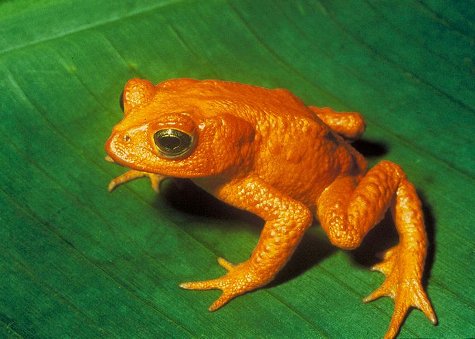
The first recorded account of the Golden Toad was by herpetologist Jay Savage in 1966, and the last sighting of the species was made in 1989. The toad, showcased by its brilliant golden orange colorization, was native to the tropical cloud forests which surround Monteverde, Costa Rica.
Their extinction symbolizes a large scale decline in amphibian numbers worldwide over the last several decades, which has likely been caused by global warming and climate change. In fact, famed Australian biologist Tim Flannery has described the extinction of the Golden Toad to be the first demise of a species due primarily to global warming.


The Caribbean Monk Seal was the only known seal which was native to the Caribbean Sea and the Gulf of Mexico. It is also the only species of seal to go extinct directly due to human causes. It was officially declared extinct on June 6th, 2008, although the last recorded account of the species was made at Serranilla Bank between Honduras and Jamaica in 1952.
Their eventual demise, brought on by human hunting, was symbolized during Columbus’ 1494 voyage, when the tiny seals were described as “sea wolves” and 8 were recorded to have been killed and slaughtered for their meat.


Tasmanian Tiger & Quagga


The last Tasmanian Tiger or Thylacine died at Hobart Zoo in Tasmania, Australia on September 7, 1936. The picture of the last Tasmanian Tiger shown above is Benjamin who was suspected to have died of neglect after being locked out of its sheltered quarters due during extreme weathers. The biggest cause for these animal extinction in the wild was a massive hunting campaign instituted by the Tasmanian government from 1888 to 1909, justified because the Tasmanian Tigers were believed to be a threat to sheep and hens.


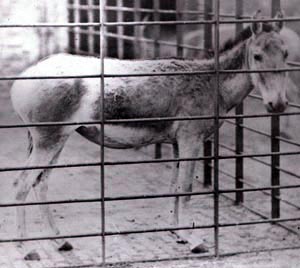
The Quagga is a unique variety of Plains Zebra, marked by its stripes on the front of its body, with hair color transitioning toward a light brown or tan along its rear and underbelly, until becoming white along its legs. This picture represents the only Quagga ever to have been photographed alive, taken at the London Zoo in 1870. Its unique hide made the Quagga a target for hunters and poachers, and the last known wild Quagga was probably killed in the late 1870′s. The species went extinct on August 12th, 1883, when the last specimen died at a zoo in Amsterdam, The Netherlands.

Friday, April 29, 2011

11 More Extinct Animals

Today, I found an article on Google about 11 extinct animals. In my next few blogs, I will be introducing those animals but in the meantime, here are the pictures of them.


Anita B. Gorman Conservation Discovery Center

           In high school, I took AP Biology and each month in each class we had to read and respond to an article in the Missouri Conservation magazine. At that time, things did not matter to be as much as it do today. Going to the Anita B. Gorman Conservation Discovery Center made me realize many things. I know my blog is suppose to be about animals who are endangered or going extinct due to global warming but going to the discovery center made me realize how ungrateful humans are. It is because of humans that the balance between humans are not balance in any way. Looking at the displays on the wall and in the classrooms and reading about it, I know that is is imposssible to give those animals an evironment that they want and need because what is left of it is impossible for them to live in. Hunting and constructions have killed many those animals off. In many ways, we are responsible for what happens to them.

What we can do to help


To learn more about how you can help those animals in endangered visit:


What is the Endangered Species Act of 1973?


            The Endangered Species Act of 1973 is one of the dozen environmental laws the United States passed in the 1970s. The act signed by Richard Nixon on December 28, 1973 was designed to protect critically imperiled species from extinction. The Endangered Species Act of 1973 was written by a team of lawyers and scientist, including the first appointed head of the Council of Environmental Quality (CEQ); Dr Russell E. Train. 
             Under the leadership of Dr. Train, the staff incorporated dozens of new principles and ideas into the legislation and crafting a document that completely changed the direction of environmental conservation in the United States. 
            
To understand more about the Endangered Species Act of 1973, visit this website for more information: 

Tuesday, April 26, 2011

Leatherback Sea Turtle


  • Fact: The largest of all sea turtles, leatherbacks are also the deepest divers of any reptile species, reaching documented depths greater than 4,000 feet
  • Location: They are located globally in the oceans
  • Global Warming Impacts: Rising seas and stronger storms threaten breeding beaches and nests. Hotter beaches result in lower hatching rates and fewer male hatchlings. Warmer seas may slow currents sea turtles ride to forage and travel
  • Status: Endangered under the Endangered Species Act